
Published on
December 5, 2025
Share on
.svg)
.svg)
.svg)

.png)
Over the past few years, one theme has guided nearly every decision I’ve made as Mayor: we can’t keep doing things the way we’ve always done them. Decatur has decades of paper records, aging systems, and processes built for another era. Modernizing those systems isn’t just about convenience, it’s about supporting our employees, improving service to residents, and (most importantly) building a community where people want to stay.
AI has become a key part of that journey. We’re still learning, and there’s a lot we don’t know yet, but I’ve already seen real, practical value in how these tools help us work smarter.
Digitizing decades of paper records forced us to rethink how information flows through City Hall. As we’ve gotten everything scanned and organized, we realized we need tools that could help us actually use that information. I know we are not alone in this as so many cities across the country are undergoing similar efforts.
For me, modernization boils down to this: make local government more efficient for the people doing it, and more approachable for those we serve.
That mindset, not just technology, is what drives everything else.
Ultimately, I don’t want our city to lag behind. We are working hard to build a place where a new generation of residents want to stay, which is why modernizing is so important.
Government often lags behind private industry, but regularly attending conferences has helped me stay ahead of new tools available to cities our size. Here are a couple of my favorites: The annual AIM Ideas Summit and the Mayors Institutes provided by AIM and Ball State University.
These conferences are more than just a chance to see what’s the latest and greatest in the field, but also a chance to meet with my counterparts in other cities and learn more about what’s working for them.
I love this opportunity to connect and compare notes with other Mayors and city leaders from across the state. Beyond the community that these conferences foster, why reinvent the wheel if a solution is working for another city?
Even when I’m not attending a conference, I make a point of staying connected with other governmental leaders. By keeping an eye out for news about new tech or processes they are implementing, I aim to combat that lag in progress that government typically faces. If a tool is working for a city, I will reach out to learn more about why they love it before deciding if it’s a potential good fit for Decatur.

In the vein of learning from each other, I want to share some tools that we’ve seen real value from.
One tool we adopted early was SeeClickFix. It is a reporting software for our residents. One of my favorite things about SeeClickFix is that It is a resident-facing app, which allows users to drop a pin and report an issue from anywhere in Decatur.
Beyond having the ability to preventatively gauge the need for repairs and maintenance citywide, this software also holds us accountable to residents for fixing emergent issues. Before SeeClickFix, I had a resident call me directly about an issue with a street light. I was unaware that they had already called another department four times before reaching out to me - and that was over the course of three months. I had no idea that no one was getting back with them.
This system created an unexpected benefit: it improved accountability. Now with SeeClickFix, I have direct access to see where our residents need us. I’m very passionate about being available to the citizens of Decatur, and with tools like this I can honor their needs and communicate more openly with them about the status of their help requests. Going forward, I’m looking to build daily dashboards that alert me when issues go too long without updates. My intention is to ensure that residents always feel comfortable reaching out to me, but never need to wait until they’re frustrated with the city to do so.
Another company we are in discussions with is Vialytics. Their software would allow the City of Decatur to regularly monitor the state of our roads. With this tool, we would be able to put cameras on a variety of our city work vehicles, including street sweepers and trash trucks. We then use the footage to monitor cracks and potholes for damage levels and even help inventory our street signs. In combination with the tools we’ve already adopted, I believe that Vialytics can help the city of Decatur focus on proactive and preventative measures to support our infrastructure.
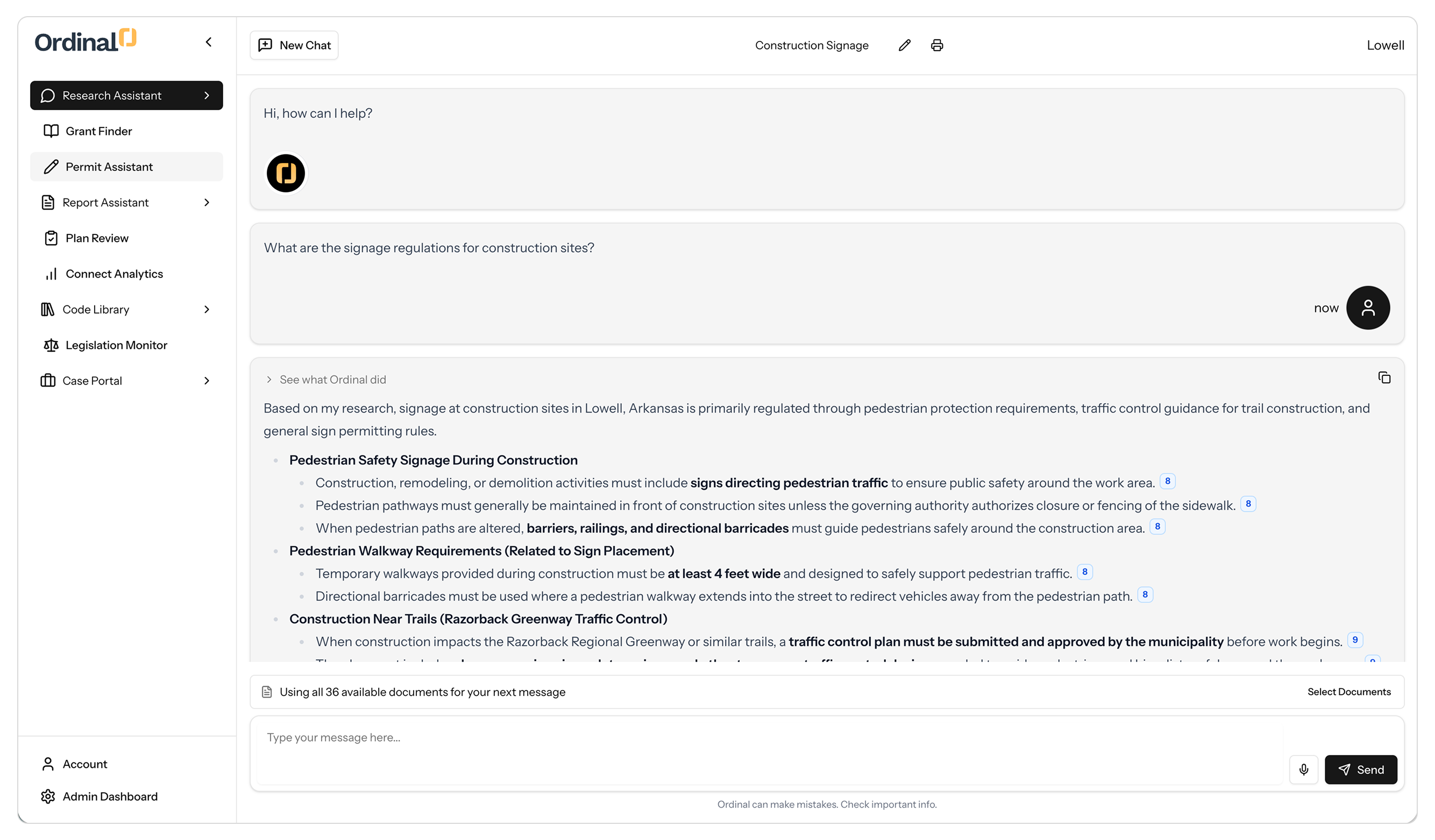
One of the most impactful tools we’ve implemented is Ordinal, an AI-powered search tool that helps us navigate our ordinances and internal documents within seconds.
Before Ordinal, answering certain ordinance questions could take me half an hour with a stack of books. Now, I simply type a keyword and I’m immediately directed to the right sections. Recently, two residents came to me about an issue with a local business, wanting to know the specifics of a noise ordinance that, prior to implementing Ordinal, would have taken me more than 30 minutes to research for them. With a simple search, Ordinal brought up everything within our records that had to do with this type of nuisance. One of the residents was nervous when I mentioned that Ordinal was an AI tool, but when I showed her that I found the answer she was looking for in ten seconds versus the half an hour it would have originally taken me, she was pleased with the city’s decision to prioritize efficiency with Ordinal.
The biggest improvement, though, is how Ordinal helps our front-line employees. If building and zoning staff aren’t in the office, our admins can still answer ordinance questions confidently and accurately. This reduces the number of times residents are asked to “call back tomorrow,” which improves their overall experience and builds trust between residents and the city.
Looking ahead, I’m especially excited about Ordinal Connect, which will let residents look up answers themselves. This will save even more staff time and empower residents to find information any time.
AI can feel intimidating at first, especially with the stories circulating in the news. When we introduce new technology, we bring in experts to speak directly with our city council and staff. For example, we had someone from Ordinal attend a city council meeting to explain what the tool does and answer questions directly. I learn a lot at conferences, but I also know that I can't always explain things the way the experts can. Letting staff hear directly from the people who build these tools has made adoption much easier for our teams.
As a Mayor or leader in your local government, leading by example also helps ease minds during tech transitions. As my staff have seen me actively using Ordinal and SeeClickFix, they have been more likely to do the same.
Modernization is not always digital. Previously, residents of Decatur were permitted up to six bags of trash to be manually picked up from their curbs on trash day. Recently, we had to make a swift decision to modernize that process when not one but two of our sanitation workers were seriously injured. One tore his shoulder from lifting a deceptively heavy bag, and another was injured by needles that were concealed in the bag when he went to grab it. This was unacceptable for obvious reasons, so we used some COVID-19 funding we’d set aside and invested in standardized trash bins and mechanized collection trucks.
It wasn’t cheap, but it was the right decision. Our employees are safer, routes are more efficient, and our streets look cleaner. Initially we were concerned because the standardized bins meant people could only fit a few bags each trash day, but by also providing recycling bins as part of this initiative, our residents showed us a surprising benefit to this decision - with the limited trash space in their bins, they began recycling more. It was so gratifying to see that a decision we made out of an urgent concern for our staff’s safety had such a positive impact on our city.

After college, I worked in continuous improvement in the private sector. That mindset shapes everything I do today. I’m constantly asking:
Many cities keep outdated processes simply because “that’s how we’ve always done it.” I encourage my team to question every assumption and look for smarter ways to work. I have a monthly meeting with my department heads to address the problems they are facing and together, we work through potential solutions. Having dedicated time for this has really made an impact and brought new ideas to the table.
The process improvement doesn’t just stop with my staff - it extends to our solutions, like Ordinal. One thing I appreciate about the team behind Ordinal is how committed they are to partnership. Not only do they regularly reach out to me and to our department heads to troubleshoot issues, they also work with us to brainstorm possible integrations with other tools we already use. Their genuine interest in helping the city of Decatur work better is something I truly value.
Prioritizing needs is one of the hardest parts of being mayor. Everyone has their own top priorities, and because these issues are paramount to them, people often assume the issue they’re most concerned about should be priority number one for the city. It takes careful balance of budget, time, capacity, and resident needs, which often feels more like an art than a science.
To make good decisions, I lean on a range of voices—including my mayor’s youth council. It matters to me that as Mayor I get a range of perspectives to ensure I’m triaging issues residents are concerned about effectively. The Youth Council is doubly beneficial, because it gives us insight into what the next generation of residents wants to see in their city. If we want young people to choose to stay in Decatur, we need to understand what they value. It’s easy to get this information - you just have to open the dialogue, then sit back and listen.
The Youth Council’s impact has been immediate. Their perspective has shaped several of our priorities around parks and amenities. What seems “fine” to a 70-year-old might not appeal to a 17-year-old deciding where to live after graduation. Having their feedback and participation in council meetings and city events not only shows my commitment to my campaign policies, but my commitment to Decatur’s future.
Resident receptiveness is a big factor in solution adoption. Recently, we made the decision to implement the first traffic roundabout in our county. The roundabout is placed at a five-way intersection, where it’s difficult for drivers to know whose turn it is. It caused a lot of problems and was a high-risk site for accidents. Despite knowing firsthand how problematic this intersection was, residents were initially very critical of the project. Social media was buzzing with a hive mind of negative sentiments, so we had to go on a new campaign to ease their minds. There's a city about an hour and a half south of Decatur, with a population of roughly 100,000 people. I explained to residents who were critical of the roundabout that this neighboring city has 130 roundabouts and just one stoplight in the entire city. It was important to me that our residents have a proof of concept to compare this initiative to.
While we were able to change some minds, we still faced pushback about the roundabout’s construction. Ultimately, my team and I knew it was necessary, so we went through with our plans. The decision paid off - once our residents saw the landscaping, which involved 600 plants being added to beautify the roundabout, and the stamped concrete crosswalks — not to mention how much better traffic is — public opinion swiftly changed. Today, most residents appreciate the roundabout. It’s efficient, landscaped, and aesthetically pleasing. While those first few months were rough, sometimes the decisions that are hardest up front turn out to be the best decisions in the end.

I have a few pieces of advice for other mayors looking to modernize their city hall.
First and foremost, stay open-minded. It can be easy to make snap decisions on new technology, but as it evolves, assumptions you made at first may change. AI is becoming more and more reliable and ubiquitous every day.
Secondly, learn from other mayors! You don’t need to reinvent the wheel every time. Connect with other mayors (even just from surrounding cities) and discuss how you are implementing new technology and practices. Then borrow from their lessons learned.
Lastly, don’t be afraid to try something new. We all know that change is difficult, but a stagnant city isn’t a healthy city. I’d challenge you to find 2-3 projects each year to improve the processes that help run your team. Whether that's new technology, a new type of meeting with your department heads, or improving old standards, making this effort will show your team you’re invested in their future, not just getting by day-to-day.
I hope you’ll include me on that list of mayors you connect with - I’m eager to share my experiences and learn from you, as well.

Ready to see Ordinal in action? Book some time with our team and we’ll show you just how valuable this could be for you and your staff.

We create innovative solutions that simplify complexities and empower success for communities everywhere.


Copyright 2025 - BreakGround Technologies


