
Published on
November 17, 2025
Share on
.svg)
.svg)
.svg)

.png)
A few weeks ago, our CEO Jacob Herrington shared a simple observation on LinkedIn:
“City Hall closes at 5 p.m. sharp. Which is also, coincidentally, the exact moment most residents realize they need to call City Hall. 😂”
That post struck a nerve, generating a wave of thoughtful comments from planners, policy advisors, and city staff across the country. The conversation made something clear:
Cities everywhere are wrestling with the same challenge—how do we meet resident needs when most of those needs happen after business hours?
This article was prompted by that discussion. The comments were too insightful not to turn into a deeper exploration of what it really means to build a 24/7 city.
If you’ve ever worked in local government, you know the pattern: The moment staff lock the door, the questions start rolling in.
Planning questions.
Permit confusion.
“Who do I talk to about this fence?”
“What do I do about a neighbor’s short-term rental?”
“Where do I report this issue?”
Residents aren’t being difficult, they’re just busy, juggling work, childcare, and life. But the demand for clarity doesn’t stop at 5 p.m.
As one commenter put it, many public employees feel this pressure personally.
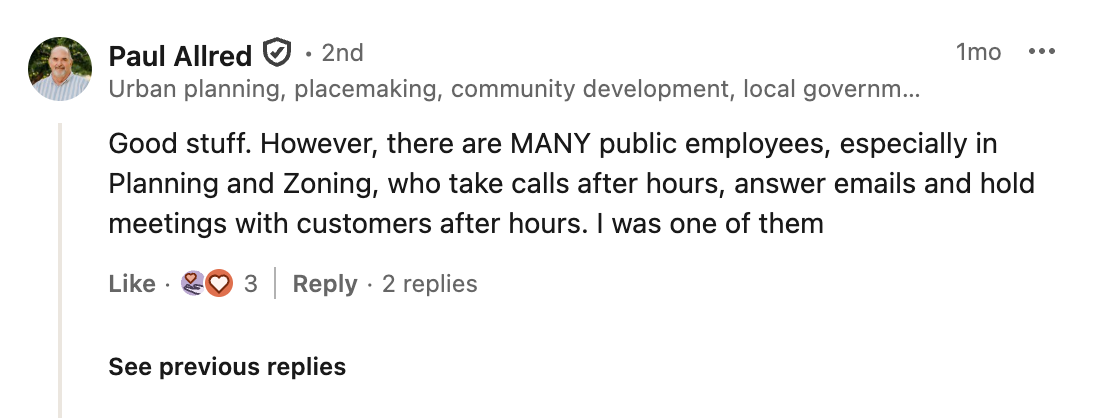
“There are MANY public employees, especially in Planning and Zoning, who take calls after hours, answer emails and hold meetings with customers after hours. I was one of them.”
— Paul Allred, Urban Planner
City staff care deeply and often go above and beyond. But relying on personal sacrifice isn’t a sustainable accessibility strategy.
On this topic, several practitioners jumped in to share real, practical examples of how their cities are bridging the accessibility gap.
Some cities are experimenting with staying open later on select days.
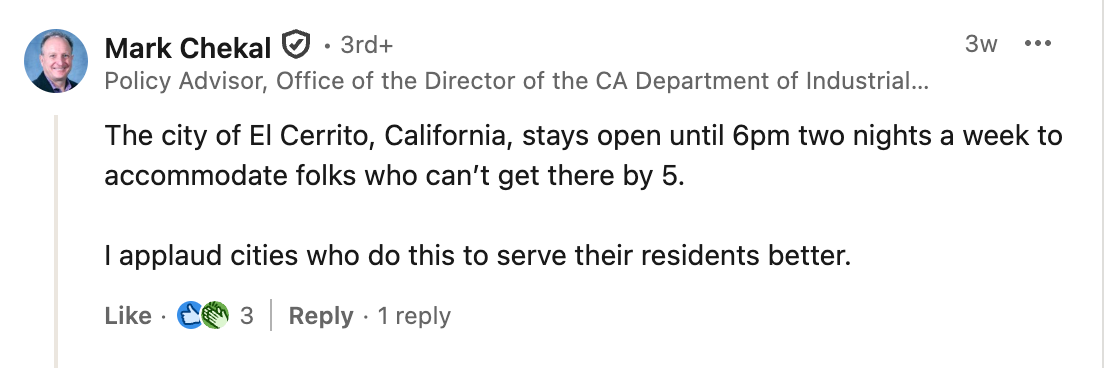
“The city of El Cerrito, California, stays open until 6pm two nights a week to accommodate folks who can’t get there by 5. I applaud cities who do this to serve their residents better.”
— Mark Chekal, Policy Advisor
Not every city can extend staff hours. But when they can, even small changes make a meaningful difference for working families. Even just a few nights a week, or a rotating shift could help lower the burden.
One of the most powerful (and overlooked) tools?
A well-written, plain-language FAQ.
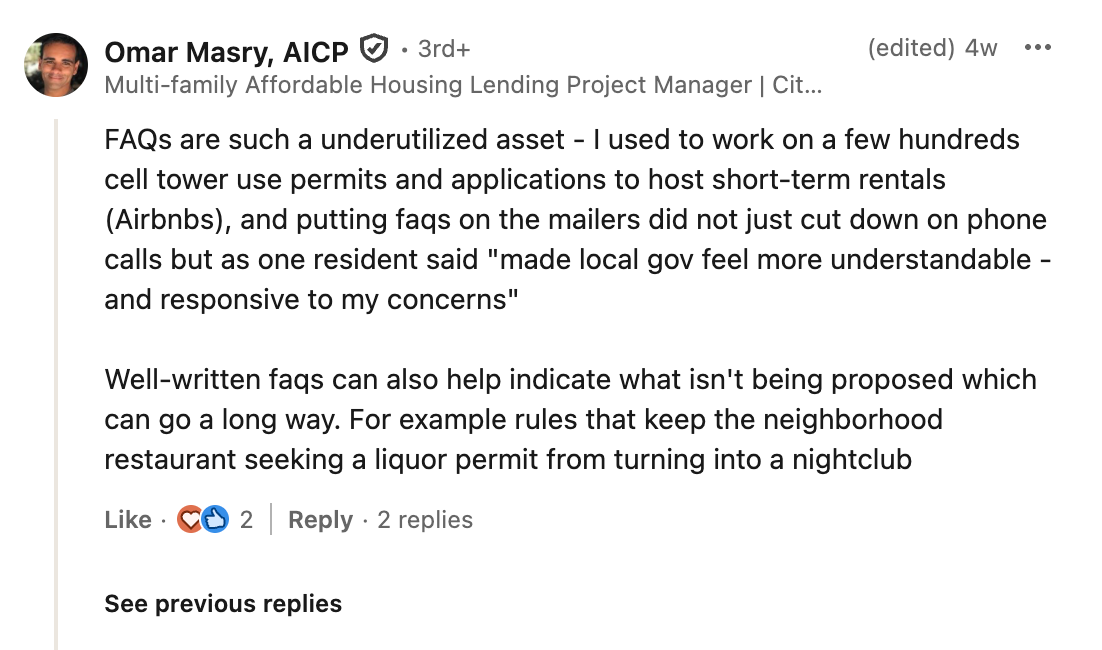
“FAQs are such a underutilized asset - I used to work on a few hundreds cell tower use permits and applications to host short-term rentals (Airbnbs), and putting faqs on the mailers did not just cut down on phone calls but as one resident said ‘made local gov feel more understandable - and responsive to my concerns’
Well-written faqs can also help indicate what isn't being proposed which can go a long way. For example rules that keep the neighborhood restaurant seeking a liquor permit from turning into a nightclub.”
— Omar Masry, AICP
Clarity eliminates confusion and reduces misinformation.
Others pointed out that after-hours challenges are often a symptom of processes that are too complicated in the first place.
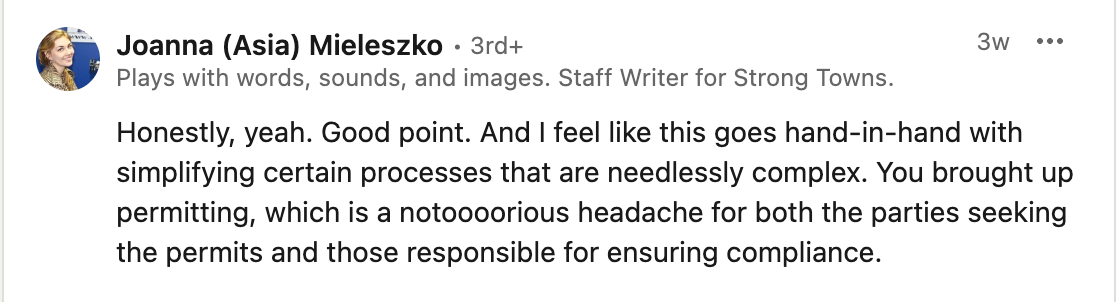
“This goes hand-in-hand with simplifying certain processes that are needlessly complex… permitting is a notorious headache for both the parties seeking the permits and those responsible for ensuring compliance.”
— Joanna (Asia) Mieleszko, Strong Towns
When complexity drops, so does after-hours frustration. Many cities have digitized their applications, allowing residents and businesses to fill them out online. Being able to track status is next-level transparency that could prove valuable to both the city and the applicant.
Cities are also finding new ways to give residents self-service access (without adding more staff.)
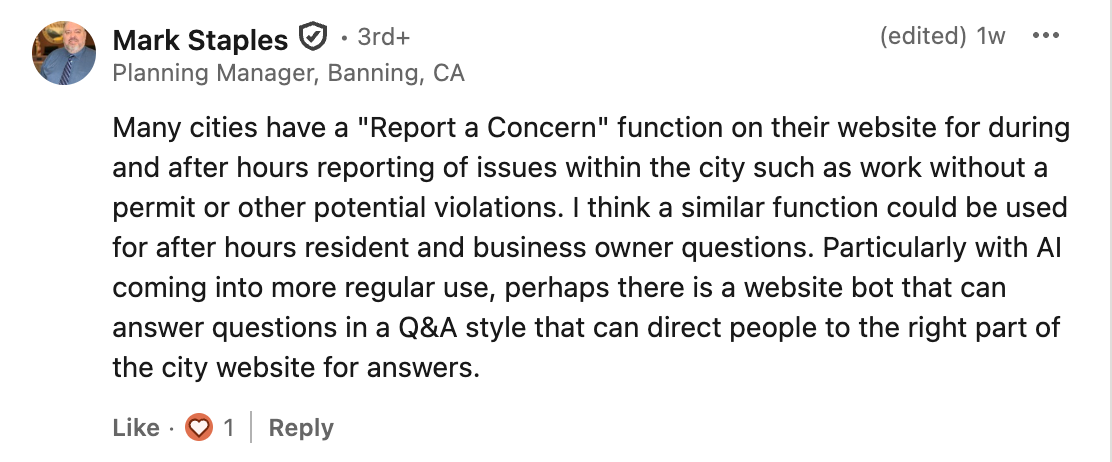
“Many cities have a ‘Report a Concern’ function… I think a similar function could be used for after-hours questions. Particularly with AI coming into more regular use, perhaps there is a website bot that can answer questions in a Q&A style that can direct people to the right part of the city website for answers.”
— Mark Staples, Planning Manager
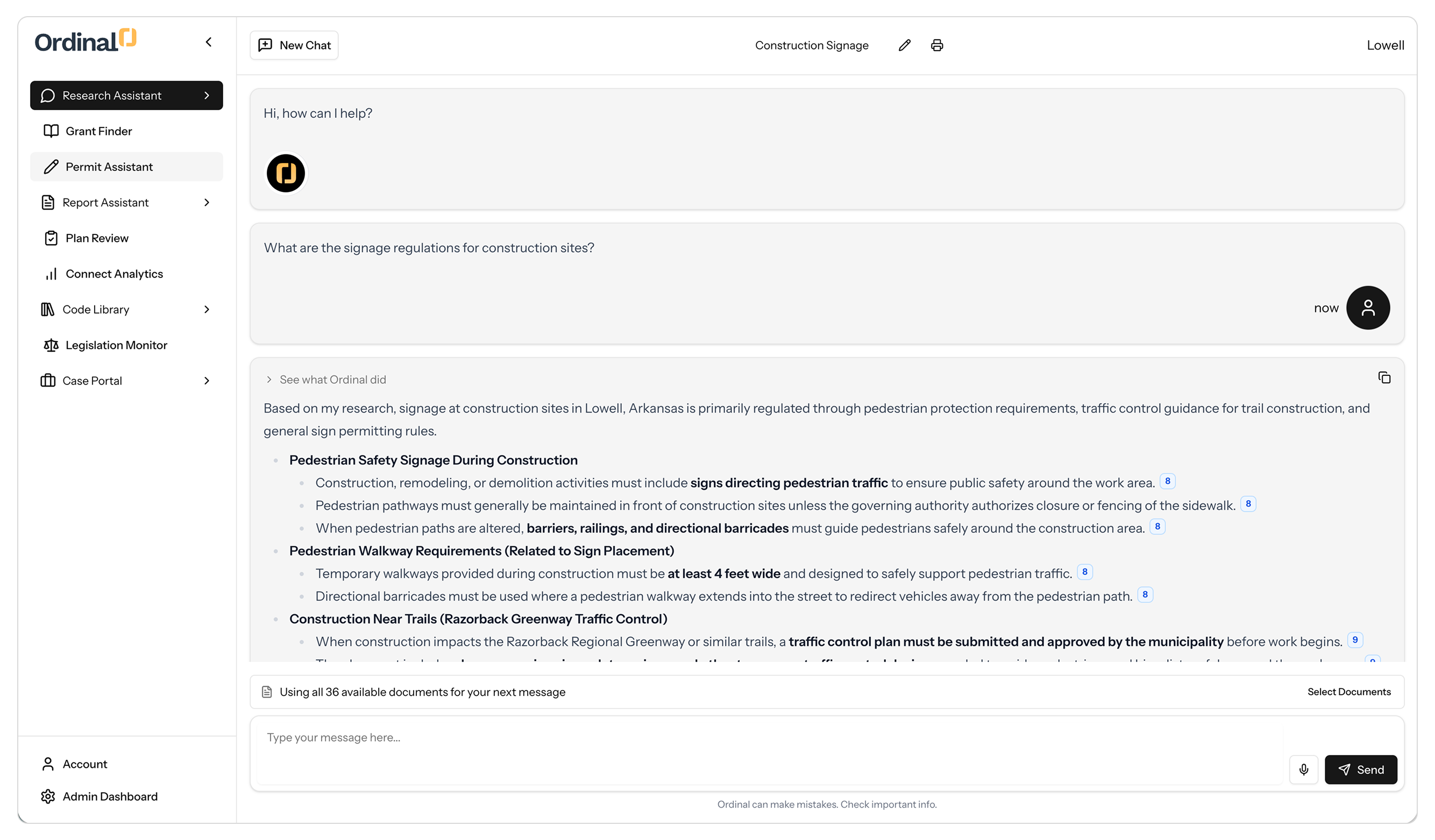
This is exactly where tools like a website chatbot or Ordinal Connect shine. They give residents help in real time, without depending on someone picking up the phone.
A true “24/7 City” isn’t about keeping staff on the clock. It’s about giving residents access to information whenever they need it. In a modern city, people can find answers in plain language, complete permits and licenses through self-service tools, report issues anytime, and rely on AI to handle simple questions. Information is ideally organized, searchable, and up to date. WIth this, the workload shifts from staff to systems.
When cities provide this level of access, everyone benefits. Residents get answers immediately, staff avoid morning call pileups, projects move faster, and frustration drops. Trust grows, and employees regain the time they need for the work that makes a bigger impact on your city.
Here are low-lift, high-impact steps cities can take right away:
Small improvements in clarity create big improvements in access.
Jacob’s LinkedIn post sparked a wave of important stories—not just about frustration, but about innovation. Cities are stepping up, experimenting, and building the infrastructure that makes government feel more responsive and human.
And the truth is, the 24/7 city isn’t a future vision. It’s already happening.
Not because City Hall is open late, but because access no longer depends on the front door being unlocked.
And the cities that embrace this reality will be the ones that thrive in the years ahead.

Ready to see Ordinal in action? Book some time with our team and we’ll show you just how valuable this could be for you and your staff.

We create innovative solutions that simplify complexities and empower success for communities everywhere.


Copyright 2025 - BreakGround Technologies


