Comparing Land-Use Frameworks: Euclidean Zoning, Form-Based Codes, and Data-Driven Planning
Published on
September 23, 2026
Share on
This brief explores how American municipalities, having long depended on conventional Euclidean zoning to separate distinct uses and manage density, are increasingly embracing Form-Based Codes (FBC) to cultivate pedestrian-friendly environments and expanded housing options. By shifting focus from activity regulation to physical building massing, street frontages, and urban design, FBC offers an alternative to strict segregation. Rather than choosing between binary frameworks, modern local governments utilize spatial analytics alongside digital code platforms to combine both models strategically—catalyzing urban infill and commercial core revitalization via form-based standards, while maintaining single-use regulatory predictability where appropriate.
For nearly a century, American municipal planning has largely operated under single-use regulation. Established after the 1926 Supreme Court ruling in Village of Euclid v. Ambler Realty Co., conventional "Euclidean" zoning categorizes land by activity—separating residential, commercial, and industrial areas to manage incompatible uses and protect public welfare.
As community needs evolve around housing supply, walkability, and economic vitality, many local governments are exploring alternative frameworks, most notably Form-Based Codes (FBC). Rather than focusing primarily on land use, form-based codes regulate the physical form, scale, and placement of buildings relative to the public street.
Both approaches offer distinct operational advantages and trade-offs. Understanding their structural differences, empirical outcomes, and implementation requirements helps municipal leaders determine the best fit for their local context.
Traditional Zoning vs. Form-Based Codes: A Structural Comparison
Each regulatory model approaches the built environment from a different baseline:
Metric / Dimension
Traditional Euclidean Zoning
Form-Based Codes (FBC)
Primary Regulatory Focus
Segregation of uses (residential vs. commercial vs. industrial)
Building mass, height, frontage, and street relationship
Public Realm Approach
Setbacks, large parking minimums, auto-oriented buffers
Build-to lines, active street walls, pedestrian-first sidewalks
Housing Development
Distinct low-density and high-density zones; straightforward for greenfield development
Integrated mix of typologies (e.g., duplexes, townhomes, courtyard apartments)
Administrative Process
Familiar statutory process; relies on rezoning and variances for mixed use
Clear objective design standards with by-right approvals; requires upfront calibration
Code Structure
Text-heavy legal standards and dimensional tables
Highly visual regulating plans, diagrams, and building envelope matrices
Scroll sideways to see the full table.
Examining the Empirical Outcomes
Comparative research evaluates how development patterns, housing markets, and municipal finances respond under different zoning frameworks.
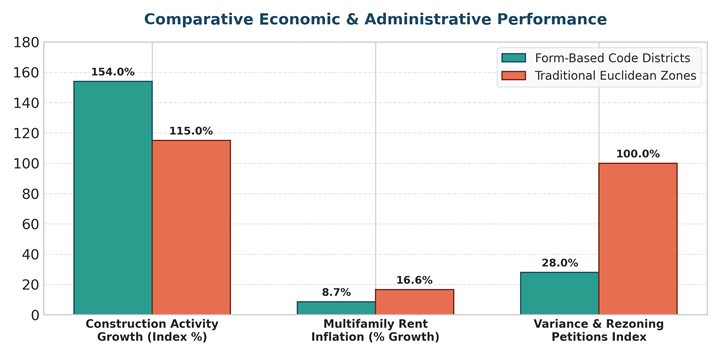
Construction Activity & Infill Growth: Studies published by Smart Growth America indicate that districts governed by form-based codes averaged a 154% increase in construction activity, driven largely by infill and multifamily projects, compared to 115% in conventional Euclidean zones. Euclidean zoning often facilitates rapid greenfield development, while form-based codes are frequently leveraged to stimulate complex urban infill.
Housing Costs & Supply Dynamics: Longitudinal research featured on CNU Public Square found that multifamily rent inflation grew at 8.7% in form-based areas compared to 16.6% in conventional areas. Expanding allowable housing typologies by-right can increase unit supply and moderate rent growth, though market outcomes remain heavily influenced by broader regional economic factors.
Fiscal Performance: Compact, mixed-use patterns often generate higher tax yields per acre with lower infrastructure maintenance costs. Conversely, Euclidean frameworks remain simpler to administer and lower in upfront transition costs for jurisdictions prioritizing low-density commercial or industrial business parks.
Permitting & Administrative Predictability: Objective physical criteria can reduce variance petitions and discretionary review cycles. However, drafting and administering an FBC requires specialized staff training and comprehensive initial public engagement to avoid misalignment during enforcement.
Figure 1: Economic and administrative performance metrics comparing Form-Based Code districts with traditional Euclidean zones.
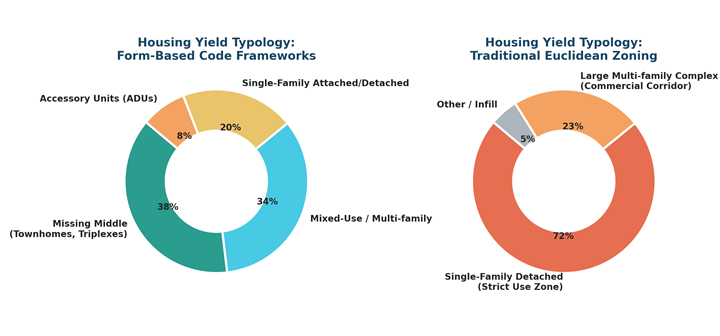
Figure 2: Distribution of housing yield typologies under Form-Based Codes versus conventional single-use Euclidean zoning.
Adoption Trends Across North America
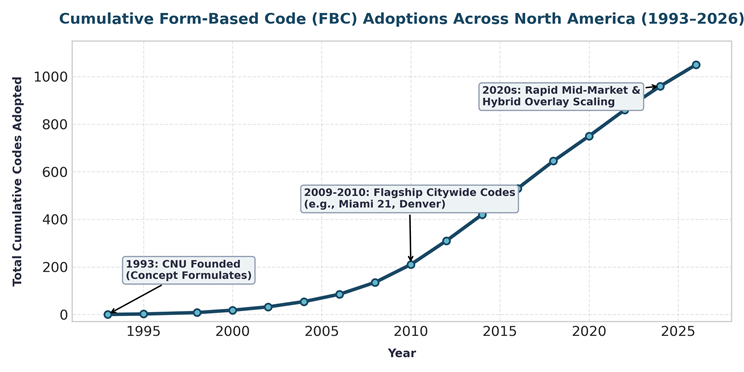
Since the founding of the Congress for the New Urbanism in 1993, form-based codes have expanded from experimental pilot projects into established regulatory tools. Early adoption was gradual throughout the late 1990s, followed by accelerated adoption after 2010 as mid-sized and large municipalities explored hybrid frameworks.
Figure 3: Cumulative Form-Based Code adoptions across North American municipalities since the founding of CNU in 1993.
Real-World Applications and Trade-offs
Municipalities utilize different regulatory structures depending on local priorities, development maturity, and administrative capacity:
Citywide Implementation (Miami, Florida): Under Miami 21, Miami replaced its traditional zoning code with a citywide transect-based framework to guide dense, transit-oriented growth across established neighborhoods. While it established a cohesive urban fabric, managing large-scale code transitions requires continuous administrative adjustments and substantial staff resources.
Targeted Corridor Overlays (Arlington County, Virginia): Rather than overhauling its entire jurisdiction, Arlington County applied a form-based overlay to the Columbia Pike corridor. This allowed the county to secure mixed-income housing and walkable streetscapes along a major arterial while preserving existing single-family zoning in surrounding neighborhoods.
Hybrid Approaches in Growing Municipalities: Many communities choose not to adopt an all-or-nothing approach. Instead, they maintain traditional Euclidean zoning for industrial and single-family suburban sectors, while applying form-based overlays to historic downtowns, commercial retrofits, and transit nodes.
How Data and Analytics Inform Regulatory Decisions
Whether evaluating Euclidean zoning, form-based codes, or hybrid models, local governments increasingly rely on data analytics to test regulations before enacting them:
Spatial Parcel Auditing: Geographic Information Systems (GIS) and 3D modeling enable planning departments to test bulk, height, and setback scenarios across parcel inventories, identifying potential non-conformities before ordinance adoption.
Digital Code Navigation: Modern digital code platforms structure complex dimensional rules and visual standards into searchable, web-native systems, making regulations easier to interpret for staff, developers, and residents.
Empirical Process Tracking: Tracking variance requests, rezoning petition volumes, and permitting timelines provides objective feedback on where a code is working efficiently and where it creates administrative friction.
Choosing the Right Path Forward
No single zoning model fits every community. Traditional Euclidean zoning continues to serve jurisdictions seeking straightforward separation of incompatible industrial uses and standard low-density development. Form-based codes offer an effective framework for municipalities aiming to foster walkable, mixed-use neighborhoods and diversify housing types. By pairing clear community goals with data-driven code audits, municipal leaders can implement the regulatory structure that best aligns with their long-term vision.
Rick Barry
Advisor, Director of Operations for Satellite Locations and Admin Services at NorthWest Arkansas Community College
Book Your Demo
Ready to see Ordinal in action? Book some time with our team and we’ll show you just how valuable this could be for you and your staff.

.svg)
.svg)
.svg)

.png)