
Published on
March 16, 2026
Share on
.svg)
.svg)
.svg)

.png)
An AI government chatbot is a software tool that uses artificial intelligence to handle resident questions, service requests, and information lookups, with no human required on the other end of every interaction. Think of it like a knowledgeable front-desk assistant who has read every policy document your city has ever published and can share the right answer at 3 a.m. on a Sunday just as readily as at 9 a.m. on a Monday.
Local governments today are managing more service demand with the same or fewer resources. That reality is precisely why the AI government chatbot has gone from a niche experiment to one of the most widely discussed tools in public administration. These tools now handle thousands of routine citizen inquiries daily, from benefits eligibility checks to appointment scheduling, allowing human staff to focus on complex, judgment-intensive work that truly requires their expertise.
This guide breaks down what an AI government chatbot is, how it works, what it can do for your residents and your team, and what to look for when evaluating one for your city.
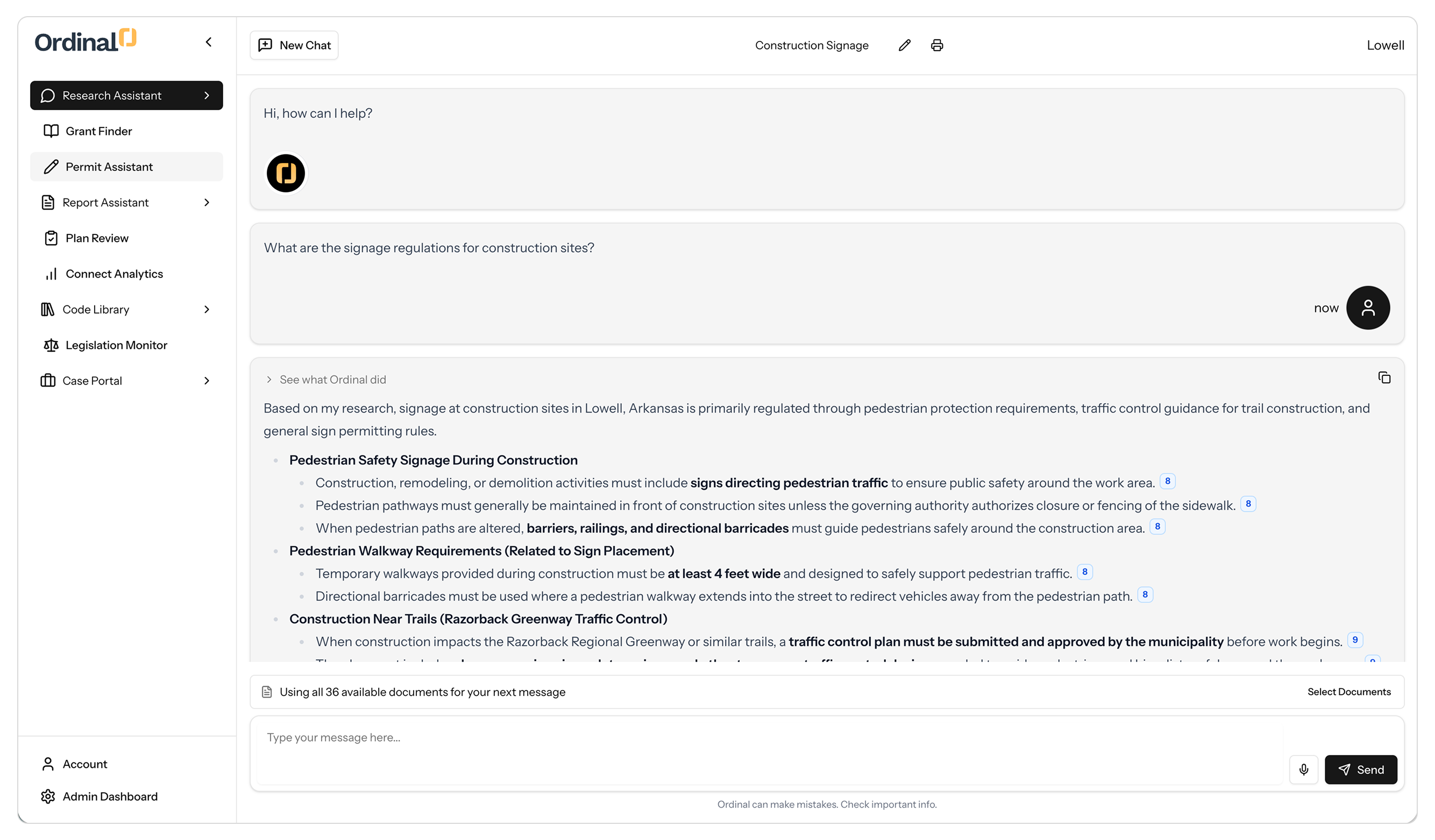
An AI government chatbot uses natural language processing (NLP) to interpret what someone is asking, even when the question is informal or imprecise. A resident can type "how do I add a deck to my house?" and the chatbot will understand that the question is about a building permit, with no technical search terms required. This is what makes modern chatbots fundamentally different from traditional keyword-search tools or FAQ pages.
Most government chatbots are powered by a method called retrieval-augmented generation (RAG). Rather than drawing answers from the open internet, a RAG-powered chatbot searches a curated library of approved documents: zoning ordinances, municipal codes, meeting minutes, and policy guides. It uses that material to generate responses grounded in documents your city has already reviewed and approved, which keeps answers accurate and defensible.
Think of RAG as the difference between asking a stranger for directions and asking your city clerk. The stranger might give a reasonable guess. The city clerk looks it up in the official records and gives you the exact answer, with a reference. Pea Ridge, Arkansas uses this kind of architecture to resolve the majority of resident inquiries on first contact.
For residents, an AI government chatbot removes one of the most persistent frustrations with local government: trying to get a clear, accurate answer during business hours. A well-built chatbot provides 24/7 access to information about permit requirements, trash pickup schedules, utility payment portals, code enforcement processes, and more, all without putting anyone on hold, routing calls between departments, or requiring a return call the next business day.
Language access is another significant benefit. Leading platforms now support more than 75 languages, meaning a resident who does not speak English fluently can access the same quality of service as a native speaker. The Center for Digital Government found that 72% of citizens want to access government information via smartphone, and AI chatbots are built for exactly that kind of mobile, on-demand interaction. Equitable access to city services matters, and chatbots that meet residents where they are go a long way toward closing that gap.
The results from early adopters are encouraging. In Williamsburg, Virginia, an AI chatbot answered 79% of resident questions on first contact, significantly reducing call-center volume. In Midland, Michigan, the city's AI chatbot and digital 311 combination resulted in faster issue resolution and better transparency for residents reporting infrastructure concerns. Raleigh, North Carolina went even further: city chatbots there now manage 90% of calls to administrative agencies, a figure that would represent a significant workload shift for any city team.
The benefits for city staff are just as significant as those for residents. In many municipalities, employees spend a large share of their workweek on information retrieval: searching for the right ordinance, asking a colleague in another department, or waiting on a subject matter expert. An AI government chatbot trained on internal documents eliminates much of that friction, giving every team member fast access to the same verified information.
Australia's Digital Transformation Agency deployed an AI assistant to more than 7,600 employees across roughly 60 agencies and found the tool saved each employee an average of one hour per day on administrative tasks. Deloitte's research on AI in government estimates that automating government employee tasks could save between 96.7 million and 1.2 billion federal work hours annually, representing a potential cost reduction of $3.3 to $41.1 billion per year. For cities with lean budgets, even a fraction of that return is meaningful.
For smaller cities, staff onboarding is another underappreciated benefit. When a new hire joins the planning department, an AI government chatbot trained on your codes means they can find accurate answers independently, without pulling a senior colleague away from active projects. For mayors and city managers evaluating AI tools, the value is concrete: staff hours reclaimed, fewer calls to redirect, and residents served faster, all without adding headcount.
Dozens of cities across the United States and around the world have already deployed AI government chatbots in active service. New York City launched its generative AI-powered MyCity chatbot in October 2023 to help residents navigate business licensing and city services. Atlanta's ATL311 Virtual Assistant, known as Ava, handles non-emergency inquiries about water bills, waste pickup schedules, and permit questions, routinely delivering responses within minutes. San Jose and other California cities have used AI chatbots to deflect routine inquiries and reduce service backlogs.
The scale of international adoption adds further context. Buenos Aires launched a resident chatbot in 2019 and expanded it steadily. By 2022, it had processed more than 58 million interactions, covering everything from social services access to construction permit applications. In Japan, a pilot chatbot developed with Mitsubishi Research Institute earned the approval of 94.7% of residents and 87.3% of municipal employees before rolling out on Japan's popular LINE messaging platform. Both cases demonstrate that AI government chatbots work across a wide range of city sizes and service models.
A 2024 analysis by StateScoop found AI chatbots deployed across state and local government websites at a growing rate, with adoption accelerating in jurisdictions that had previously relied entirely on phone and in-person service models. AI government chatbots are no longer experimental. They are operational, tested tools delivering measurable results.
For most small-to-medium cities, the question is no longer whether to adopt an AI government chatbot. The question is when and how. Gallup found that 43% of public-sector employees were using AI at least occasionally by late 2025, up from just 17% in mid-2023. Industry analysts project that 60% of government organizations will prioritize business process automation by 2026, and Future Market Insights projects the AI in government market will grow from $26.4 billion in 2025 to $60.2 billion by 2030.
The barrier to entry has dropped sharply. Where early implementations required dedicated development teams and significant IT investment, today's purpose-built platforms are designed for cities that do not have large technical departments. If your city staff regularly fields the same questions from residents about permits, zoning, billing, or service requests, a chatbot can begin handling that volume quickly, freeing your team for work that genuinely requires human judgment and discretion.
For city planners managing land use decisions, the application is especially practical. An AI tool trained on your municipal code can surface the exact regulations governing a specific parcel or use case in seconds, cutting hours of manual research from every project review and giving planners faster access to the context they need to make well-informed decisions.
Not all AI government chatbots are built the same way, and for municipalities, the differences matter a great deal. Accuracy is the most important quality. A chatbot that draws from the open internet or generic knowledge bases can give residents answers that do not reflect your specific policies. Nothing damages public trust faster than official-sounding incorrect information. Look for platforms that use retrieval-augmented generation grounded in your city's own approved documents, with citations that allow residents and staff to verify every answer at the source.
Security and data privacy are equally non-negotiable. Government chatbots handle sensitive inquiries, and any platform you deploy must meet relevant compliance standards. The GSA's AI Guide for Government recommends evaluating AI tools against principles of fairness, transparency, accountability, and privacy. That is a practical checklist for any city IT department reviewing new vendors. Data should stay within your systems, answers should trace back to verified sources, and the platform should be able to explain why it gave the answer it did.
Ease of adoption matters just as much as technical capability. The best AI government chatbot for your city is one your staff will actually use day to day. Look for tools that integrate with your existing document library and website, require minimal technical maintenance, and are designed for non-technical users at every level of city operations. If your city is also working through modernizing your municipal code and records, getting your documents organized and accessible is often the best first step, and a direct enabler of a successful chatbot deployment.
A peer-reviewed study in the journal Administrative Sciences (MDPI) identifies trust, ease of use, and perceived usefulness as the three primary drivers of AI chatbot adoption in government. That research maps directly to what city leaders report in practice: when staff trust that the chatbot is pulling from the right sources, using it becomes second nature.
An AI government chatbot is one of the most practical investments a local government can make right now. It extends your team's capacity, makes resident services more accessible and equitable, and creates a consistent, reliable entry point to city information, available any time of day, in any language, from any device.
Cities that move thoughtfully into AI adoption, starting with tools grounded in their own verified data and built for their scale, will be better positioned to serve residents well and operate more efficiently in the years ahead. The technology is ready. The data is clear. The question is simply where to start.

Ready to see Ordinal in action? Book some time with our team and we’ll show you just how valuable this could be for you and your staff.

We create innovative solutions that simplify complexities and empower success for communities everywhere.


Copyright 2025 - BreakGround Technologies


